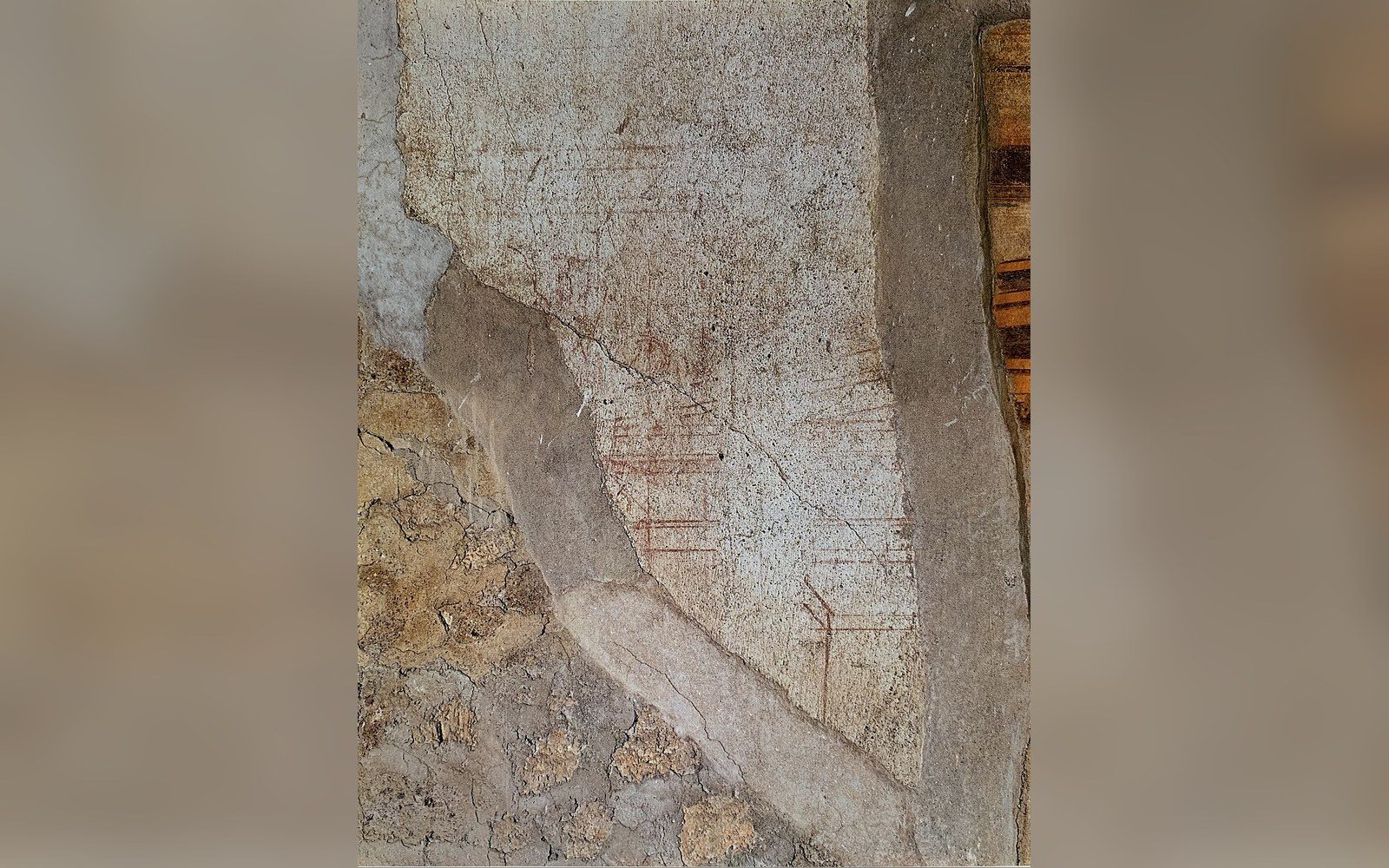
Every patch of fresh plaster is a deadline you cannot negotiate
Fresco is not a medium that tolerates hesitation. Once the final coat of lime plaster — the intonaco — goes onto the wall, it begins to absorb carbon dioxide from the air and gradually hardens. As it does, it locks in whatever pigment the painter has applied. The window is roughly a working day, sometimes less in dry heat. When the plaster sets, the painter stops, regardless of how much wall remains. This constraint is built into the very structure of the finished image, and it is still readable there, centuries later.
The unit of work is called a giornata (plural giornate): literally, a day's work. A plasterer — typically a muratore in the workshop's orbit — would lay a fresh patch of intonaco each morning over only as much wall as the painter could reasonably cover before it dried. The shape of each patch was not arbitrary. It followed the forms the painter would actually paint that day: a face, a hand, the curve of a halo, a stretch of sky. Laying more would be wasteful, because any unpainted intonaco had to be cut away at the end of the session and relaid fresh the next day, which is itself a clue to the system — the seams between patches were cut at the edges of forms, not through them.
Reading the joins
Look closely at a fresco surface under raking light, or examine a published infrared or ultraviolet survey, and the giornate become legible as a kind of map. The seams appear as faint ridges or recessed lines where one day's plaster meets the next. The sequence in which they were laid follows a logic of gravity and efficiency: painters worked from the top down, so that debris from the day's work would not fall on already-painted sections. Ceiling fields came first, then upper walls, then lower registers.
What the giornate reveal is not just technical procedure but actual decision-making about value. The largest day-patches tend to cover the least-detailed areas — broad skies, plain architectural backgrounds, expanses of drapery where one tone dominates. The smallest patches, and therefore the most time-intensive sessions, fall on faces. A portrait-quality head might occupy an entire giornata on its own, and the patch could be little larger than the head itself. Assistants could lay background giornate at a different pace from the master. The master's own hand clause in a contract finds its physical expression here: the faces are where the day's work slows down and shrinks.
The count of giornate across a whole fresco cycle is, effectively, an audit. Scholars have counted them in major Florentine and Paduan cycles to reconstruct how long a campaign actually took, cross-referencing with documented payment dates where those survive. The mathematics of giornate per week, accounting for feast days and weather, gives a working calendar more granular than most archival records can provide. The plaster itself is a ledger.
What could not wait, and what was added later
Because the intonaco had to be worked wet, certain pigments could be applied in true fresco — bound into the wall as the lime carbonated. Earth colours, the ochres and umbers, survived this chemistry well. Others did not: the copper-based blues, and the fine detail work in gold or white that sat on top of forms rather than inside them. These had to be applied a secco — dry, on already-set plaster, with an organic binder — and they are the passages most likely to have flaked away over time. The surface you see in any aged fresco is therefore a composite: what the lime accepted and preserved, and the ghost or absence of what it could not hold.
What the giornate reveal is not just technical procedure but actual decision-making about value.
The giornata boundary also marks a technical vulnerability. Where two patches meet, moisture and movement over centuries tend to open the joint. The seam that was once a tidy working edge becomes a crack, and a crack becomes an entry point for damp. Conservation work on frescoes routinely involves consolidating these joints before anything else, because the painter's daily rhythm, pressed into the fabric of the wall, is also the map of where the wall is most likely to fail.
The deadline was not imposed by a patron or written into a contract. It was written into the chemistry of the lime itself. The painter obeyed it every morning, and the wall still shows it.